
2026 Pool Fence Code Requirements: Is Your Aluminum Fence Compliant?

Look, I’m not going to sugarcoat this—pool fence regulations are confusing as hell. And honestly? That’s by design. Between federal BOCA standards, state-specific requirements, and whatever your local city council decided to add last Tuesday, it’s a maze. But here’s why you should care: every year, roughly 350 children under 5 drown in residential pools in the U.S. About 70% of those deaths happen when the kid wasn’t supposed to be swimming. A proper fence could’ve prevented most of them.
$8,000 fences that pass inspection on the first try, and $15,000 custom jobs that fail because someone thought adding decorative scrollwork was a good idea (spoiler: inspectors hate it). So let’s talk about what actually matters in 2026, what’s changed, and how aluminum fencing makes this whole compliance thing way easier than it needs to be.
The Basics: What BOCA Actually Requires (And Why)
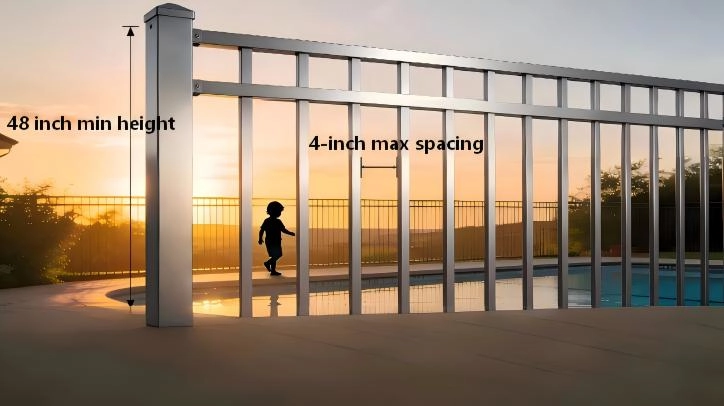
The Building Officials and Code Administrators set the federal baseline that most states follow. The big number everyone focuses on is 48 inches—that’s 4 feet of fence height minimum. But here’s what most people miss: that measurement is from the pool side of the fence, at the lowest ground point. I can’t tell you how many homeowners I’ve met who measured from the yard side where the ground’s 3 inches higher, then failed inspection.
The other critical spec is the 4-inch rule. Anywhere in your fence barrier—and I mean anywhere—if a 4-inch diameter sphere can pass through, you fail. Between pickets? Fail. Under the gate? Fail. Around a post at a weird corner angle? Believe it or not, also fail. Inspectors literally carry these test balls and they will find every gap.
Now, why 4 inches specifically? It comes down to child head entrapment studies from the ’90s. Turns out a 4-inch opening is small enough that most kids under 5 can’t get their heads through, but if they somehow do, it’s big enough they won’t get stuck. Grim stuff to think about, but that’s the logic.
The Part Nobody Talks About: Non-Climbable Design
This is where a lot of DIY fence projects fall apart. The code says no horizontal members—nothing a kid can use as a foothold—within 45 inches of the ground. Traditional wood fences with horizontal planks? Almost always non-compliant unless you specifically build them with vertical slats. Chain link? Inspectors see it as a ladder.
Aluminum fencing with vertical pickets naturally meets this requirement. The top and bottom rails are smooth, and the pickets run straight up and down. No climbing aids. It’s one of those things where the material choice makes compliance almost automatic.

State-by-State Chaos: Why California Homeowners Pay More
If you’re in California, Arizona, or Florida, you’re dealing with stricter requirements than the federal baseline. California bumped the minimum to 60 inches (5 feet) after AB 3945 passed back in 2017. I remember when that law went into effect—suddenly every fence quote I was giving went up about $8-12 per linear foot just from the extra height.
And California doesn’t stop there. Cities like Los Angeles and San Diego require pool alarms on any door within 20 feet of the pool perimeter, even if you have a compliant fence. It’s belt-and-suspenders regulation, which some people think is overkill. Me? After seeing a case where a kid got out through a doggy door while the parents were inside, I get it.
Florida’s different. The state requires 4 feet minimum, but enforcement varies wildly by county. Miami-Dade will send inspectors out randomly—I’ve heard of people getting cited during routine code sweeps. Meanwhile, rural counties might not check unless you’re selling the house or, God forbid, there’s an incident. But here’s the kicker: even if your county doesn’t enforce, your insurance company probably will. Progressive and State Farm have both started requiring photo verification of compliant fencing before they’ll issue pool coverage.
Texas does this weird “home rule” thing where cities can add requirements beyond the state code. Austin requires 5 feet in some neighborhoods. San Antonio just started requiring double-gate systems on all pool enclosures, which adds about $600-800 to the project. Always check with your specific city building department—county codes don’t override city requirements in Texas.

Why Aluminum Fences Make This Easier
I’m not going to pretend aluminum is perfect for every application. But for pool fencing? It’s honestly hard to beat(Aluminum pool fence). The vertical picket design comes pre-spaced at 3.5 to 3.75 inches—well under the 4-inch max. That spacing is done with computer-controlled manufacturing, so it’s consistent across every panel. Compare that to wood fences where spacing depends on which boards the lumberyard had in stock that day and whether your installer was having a good morning.
The corrosion resistance thing is real, too. Pool water isn’t just water—it’s got 1-3 ppm chlorine, and if you have a saltwater pool, you’re looking at 3,000 ppm salt. That’s basically ocean water. I’ve pulled out wrought iron fences after 5 years that looked like they’d been in service for 30. Rust everywhere, structural integrity shot. Aluminum forms this protective oxide layer that’s self-healing. You scratch it? The oxide layer reforms immediately. It’s the same chemistry that makes aluminum aircraft parts last decades.
The powder coating adds another layer of protection. AAMA 2604-compliant coatings—which is what you want for pool environments—are rated for 10,000+ hours of salt spray exposure. That translates to about 20+ years of real-world pool use. I’ve seen test reports from manufacturers showing zero coating failure after that kind of testing. Steel fences start showing rust at 500 hours. Even galvanized steel taps out around 3,000 hours.
Gates: Where Most People Fail Inspection
If there’s one thing that kills compliance, it’s gates. Specifically, self-closing and self-latching mechanisms that don’t actually work properly. The code requires gates to close automatically from any open position and latch without human intervention. The latch release has to be at least 54 inches from the ground—measured on the pool side—so kids can’t reach it even if they climb on something nearby.
I used to install a lot of spring-loaded hinges because they were cheap ($20-30) and homeowners liked saving money. But honestly? I’ve stopped recommending them. The springs weaken from UV exposure and constant use. Within 2-3 years, you’re looking at gates that don’t fully close or need a push to latch. That’s an instant code violation and a dangerous liability.
Now I mostly install magnetic latch systems. They run $120-180, which seems expensive until you realize they last 15-20 years with zero maintenance. The neodymium magnets automatically engage when the gate swings closed, and they don’t lose strength over time like springs do. The catch is alignment—if your strike plate is even 1/8 inch off, the magnet won’t catch properly. I learned that the hard way on my first magnetic latch install. Spent 20 minutes troubleshooting before I realized the post had settled slightly and thrown everything off.
For heavier gates or high-wind areas, hydraulic closers are the way to go. They use fluid damping to control closing speed, which prevents finger pinch injuries while ensuring the gate actually latches. They’re $150-250 and require occasional maintenance (fluid top-off every few years in extreme climates), but they’re basically bulletproof for compliance purposes.

The Inspection Process: What Actually Happens
When the inspector shows up, they’re not there to be your friend. Their job is to find violations. They carry a 4-inch test ball—sometimes it’s a softball, sometimes it’s a specialized gauge—and they test every potential gap. Between pickets, under gates, around posts, at corners, anywhere two fence sections meet. A single failure anywhere means the whole installation fails.
The other thing they do is the “wobble test.” They’ll grab posts and physically shake them to check structural integrity. Loose posts or undersized footings will show visible movement, which is an automatic fail. Gates get special attention—they’ll open and close them repeatedly to verify the self-closing operation and watch to make sure the latch engages every time.
I always tell homeowners to do their own pre-inspection before calling for the official one. Buy a 4-inch ball at any sporting goods store and walk your entire fence perimeter trying to pass it through every opening. Pay extra attention to:
Gate bottom clearance (single most common failure point)
Corner assemblies where different panel types meet
Anywhere the fence connects to your house or other structures
Spots where you have grade changes or slopes
Take photos during your self-test. If something looks borderline, fix it before the inspector sees it. Re-inspection fees run $75-150 in most areas, so getting it right the first time saves money and hassle.
Real Costs of Non-Compliance
There’s a case from 2019 that still sticks with me. Family in Sacramento—I think they were in Natomas or maybe Elk Grove—had a neighbor’s 4-year-old drown in their pool. The fence looked totally fine. Met the height requirement, had a self-closing gate, the whole deal. But when investigators came out and measured it? The picket spacing was 4.5 inches. Just half an inch over code.
The family ended up settling for something like $2.3 million. The worst part? Their homeowner’s insurance refused to pay, citing “willful code violation” in the policy fine print. I’m pretty sure they had no idea the fence wasn’t compliant—it had been installed by the previous owner. But it didn’t matter. They had to liquidate personal assets to settle. Legal costs alone ran over $180,000 before the settlement.
That’s an extreme case, but smaller violations carry real penalties too. Municipal fines typically start around $500-1,500 for a first offense, but they compound fast. Second violation in most jurisdictions runs $1,500-3,500 plus potential pool closure orders until you fix it. Miami-Dade County issued 847 pool fence citations in 2023 and collected over $1.2 million in fines. Average fine was around $1,400 per violation.
Then there’s the home sale issue. I’ve seen deals fall apart over pool fence violations. Buyers’ inspectors find non-compliant fencing, buyers demand credits for replacement, sellers refuse, buyers walk. The market’s competitive enough that most sellers just eat the cost rather than risk losing a deal.

Installation Details That Actually Matter
Post installation is where you can’t cut corners. The code requires concrete footings at least 24-36 inches deep depending on your frost line, but for pool fences I always recommend 30-inch minimum even in warm climates. Pool chemicals migrate through soil and create corrosive conditions that can deteriorate shallow footings within 5-10 years.
Footing diameter matters too. Standard 8-inch holes work for most soil, but if you’re in expansive clay territory or sandy conditions, go with 10-12 inches. Always use 3,000-3,500 PSI concrete—not the cheap 2,500 PSI “all-purpose” mix. Add fibermesh reinforcement for extra durability in pool environments.
Here’s a trick I picked up from a structural engineer: set your posts 1-2 inches higher than final grade, then cut to exact height after the concrete cures. Prevents the super common mistake of posts ending up too short after soil settling or landscape grading changes.
If you’re within 5 miles of coastline or in a designated high-wind zone, you’re probably looking at engineered foundations. That means stamped drawings from a licensed structural engineer specifying footing depth, rebar placement (usually two #4 rebar vertical bars per post), and tie-down hardware. It adds $800-1,500 to project costs, but it’s mandatory for code compliance and insurance coverage in those areas.
Common Violations and Quick Fixes

Ground Clearance Issues (about 30% of failures in my experience):
Over time, soil erosion or mulch removal creates gaps under the fence that exceed the 2-4 inch maximum. Minor violations—up to 1 inch over—can usually be fixed by adding gravel or decorative rock to raise the grade. Cost is maybe $50-150 for materials.
Moderate violations (1-2 inches over) need bottom rail extensions or aluminum “kick panels” that attach to the existing fence. Runs about $8-12 per linear foot. Severe violations—2+ inches over—might require lowering the fence by excavating and resetting posts, or just installing a new fence. That’s $15-25 per linear foot minimum.
Gate Problems (about 25% of failures):
If your gate doesn’t close, it’s usually the hinges or closer needing adjustment or replacement. Cost is typically $100-300. If it closes but doesn’t latch, adjust the latch position or replace the mechanism—$50-150. If it closes but needs a push, increase spring tension or replace the gate closer for $75-200.
Test your gates monthly. Catching failures early prevents expensive emergency repairs right before inspections.
Material Specs Worth Knowing
Not all aluminum fencing is created equal. For pool applications, you want 16-gauge or thicker pickets—that’s 0.060-0.080 inches wall thickness. Thinner materials (18-20 gauge) technically meet code but they flex under pressure, which can create spacing problems over time. Push hard on a quality fence picket—it should deflect less than 1/8 inch and immediately spring back. Cheap thin stuff flexes 1/4 inch or more and might not fully recover.
Powder coat thickness matters more than most people realize. AAMA 2604 certification requires minimum 1.2-1.4 mils thickness, but for pool environments you want the higher end—1.4-1.6 mils. Budget manufacturers apply 0.8-1.0 mil coatings that fail within 3-5 years, forcing expensive refinishing.
Posts should be 0.125 inches (1/8 inch) wall thickness minimum. Some codes require 0.156 inches. You want 2.5-inch square minimum for line posts and 3-inch for gate posts. Heavy-duty compliant posts run $45-75 each versus $20-30 for light-duty versions. For a typical 100-foot perimeter (about 14 posts), that’s a $350-630 difference. But light-duty posts risk failure within 5-10 years.

Bottom Line
Pool fence compliance isn’t optional, and aluminum makes it significantly easier to achieve and maintain. The material naturally meets most code requirements—vertical picket spacing, non-climbable design, corrosion resistance in chemical environments. Combined with proper gates and installation, you’re looking at decades of trouble-free compliance.
Get it wrong, though, and the consequences range from annoying (failed inspections, fines) to catastrophic (drowning incidents, million-dollar lawsuits, insurance denials). It’s worth investing in quality materials and professional installation upfront rather than gambling with cheap alternatives that might not pass inspection or hold up over time.
If you’re installing a new fence or questioning your existing one, do the self-inspection with a 4-inch ball. Test your gates monthly. Take photos annually to document compliance. And when in doubt, hire a pool safety inspector for $150-300 to give you professional peace of mind.
Need help ensuring your aluminum pool fence meets 2026 code requirements? Contact Rutao for a free compliance assessment and expert installation consultation.
Recommended Official Resources
Want to read the exact regulations yourself? Here are the official sources we referenced:
Federal Safety Guidelines:
CPSC Safety Barrier Guidelines for Residential Pools (PDF) – The comprehensive U.S. Consumer Product Safety Commission handbook that most local codes are based on.
ISPSC International Swimming Pool and Spa Code – Direct link to the 2021 code section 305 regarding barrier requirements.
- State-Specific Laws:
California: The Swimming Pool Safety Act (AB 3945 / SB 552) – Full text of California’s strict 7-point safety requirements.
Florida: Residential Swimming Pool Safety Act (Chapter 515) – Detailed statutes on Florida’s barrier and alarm requirements.
- Industry Standards:
ASTM F1908-08 Standard Guide for Residential Pool Fencing – The technical standard for fence materials and construction.
BOCA Pool Code Compliance Summary – A simplified breakdown of the Building Officials and Code Administrators standards.
FAQs
Q: What are the basic pool fence code requirements for 2026?
A: Federal BOCA standards require a minimum 48-inch (4-foot) fence height measured from the pool side at the lowest ground point. No gaps can exceed 4 inches anywhere in the barrier—between pickets, under gates, or around posts. The fence must have a non-climbable design with no horizontal footholds within 45 inches of the ground. Gates must be self-closing and self-latching with the latch positioned at least 54 inches high.
Q: Can I install an aluminum pool fence myself and still meet code?
A: Yes, but it’s tricky. The main challenges are ensuring proper concrete footing depth (24-36 inches minimum), maintaining exact 4-inch spacing throughout, and installing self-closing gates that actually work. Most DIY installations I’ve seen fail on gate mechanisms or ground clearance issues. If you go the DIY route, budget $150-300 for a professional pre-inspection before calling for the official one—re-inspection fees run $75-150 and you don’t want to pay that multiple times.
Q: Do pool fence requirements vary by state?
A: Absolutely. California requires 60 inches (5 feet) minimum for pools installed after 2017, plus mandatory door alarms in some cities. Florida sticks with 4 feet but enforcement varies wildly by county—Miami-Dade is aggressive while rural counties barely check. Texas lets cities set their own requirements, so Austin might require 5 feet while Houston enforces 4 feet. Arizona has exemptions for hot tubs with locking covers. Always check with your local building department.
Q: Why is aluminum better than wood or wrought iron for pool fences?
A: Aluminum naturally meets code requirements without modifications—the vertical picket spacing is pre-engineered at 3.5-3.75 inches, and the smooth rails have no climbing footholds. More importantly, it doesn’t rust or corrode in pool environments. I’ve pulled out wrought iron fences after 5 years that were completely shot from chlorine and salt exposure. Aluminum forms a self-healing oxide layer and, with proper powder coating, lasts 20+ years with zero maintenance.
Q: What's the most common reason pool fences fail inspection?
A: Gate bottom clearance, hands down. It accounts for about 30% of failures in my experience. Over time, soil erosion or mulch removal creates gaps exceeding the 4-inch maximum under the gate. The second most common issue (about 25% of failures) is self-closing gates that don’t actually close or latch properly—usually because spring hinges have weakened from UV exposure.
Q: How much does it cost to fix a non-compliant pool fence?
A: Depends on the violation. Minor ground clearance issues run $50-150 for gravel to raise the grade. Gate latch replacements cost $50-150. But if your fence height is off or picket spacing is wrong, you’re looking at $8-12 per linear foot for extensions, or $15-25 per linear foot for complete replacement. For a typical 100-foot perimeter, that’s potentially $1,500-2,500 in fixes. Way cheaper to get it right the first time.
Q: What happens if I don't have a code-compliant pool fence?
A: Municipal fines start at $500-1,500 for first offense and compound from there—second violations run $1,500-3,500 plus potential pool closure orders. But the real risk is liability. There’s a Sacramento case where a family settled for $2.3 million after a neighbor’s child drowned, and their insurance refused to pay citing “willful code violation” because the fence had 4.5-inch picket spacing instead of 4 inches. They had to liquidate personal assets to settle.
Q: Do I need a permit to replace my existing pool fence?
A: In most jurisdictions, yes. New pool installations always require permits, and fence replacements typically do too. Some areas exempt minor repairs or repainting, but structural changes need permits and inspections. The permit process usually takes 2-4 weeks and costs $100-300 depending on your location. Skipping permits can cause major problems when you sell your home—buyers’ inspectors will flag unpermitted work.
Q: How do I know if my powder coating is thick enough for pool use?
A: Ask for AAMA 2604 certification documentation. Pool environments need 1.4-1.6 mils coating thickness to withstand 10,000+ hours of salt spray exposure (equivalent to 20+ years). Budget manufacturers apply 0.8-1.0 mil coatings that fail within 3-5 years. If the supplier can’t provide test reports showing salt spray performance and coating thickness verification, that’s a red flag.
Q: Can I add decorative elements to my aluminum pool fence without violating code?
A: Maybe. Decorative scrollwork or horizontal bars are fine if they’re positioned above the 45-inch threshold and don’t create climbable footholds. But adding anything between pickets that increases spacing beyond 4 inches will cause instant failure. And piling landscaping rock near the fence base that creates ground gaps is a common violation. Always test modifications with a 4-inch ball before the inspector shows up.
