Neither Surface #2 nor Surface #3 is universally better. When comparing Low-E coating surface 2 vs surface 3 for windows, choose the coating product and whole-window U-factor and SHGC for the project's climate, orientation and shading.
Surface #2 is commonly used for solar-control Low-E coatings. Surface #3 can suit particular passive Low-E products designed to admit useful solar heat while reducing heat loss. The surface number describes placement; it does not identify a performance rating.
A cooling-dominated home with exposed west-facing glass has different priorities from a heating-dominated home with carefully shaded south-facing windows. Here is how to discuss that choice before ordering custom aluminum windows.
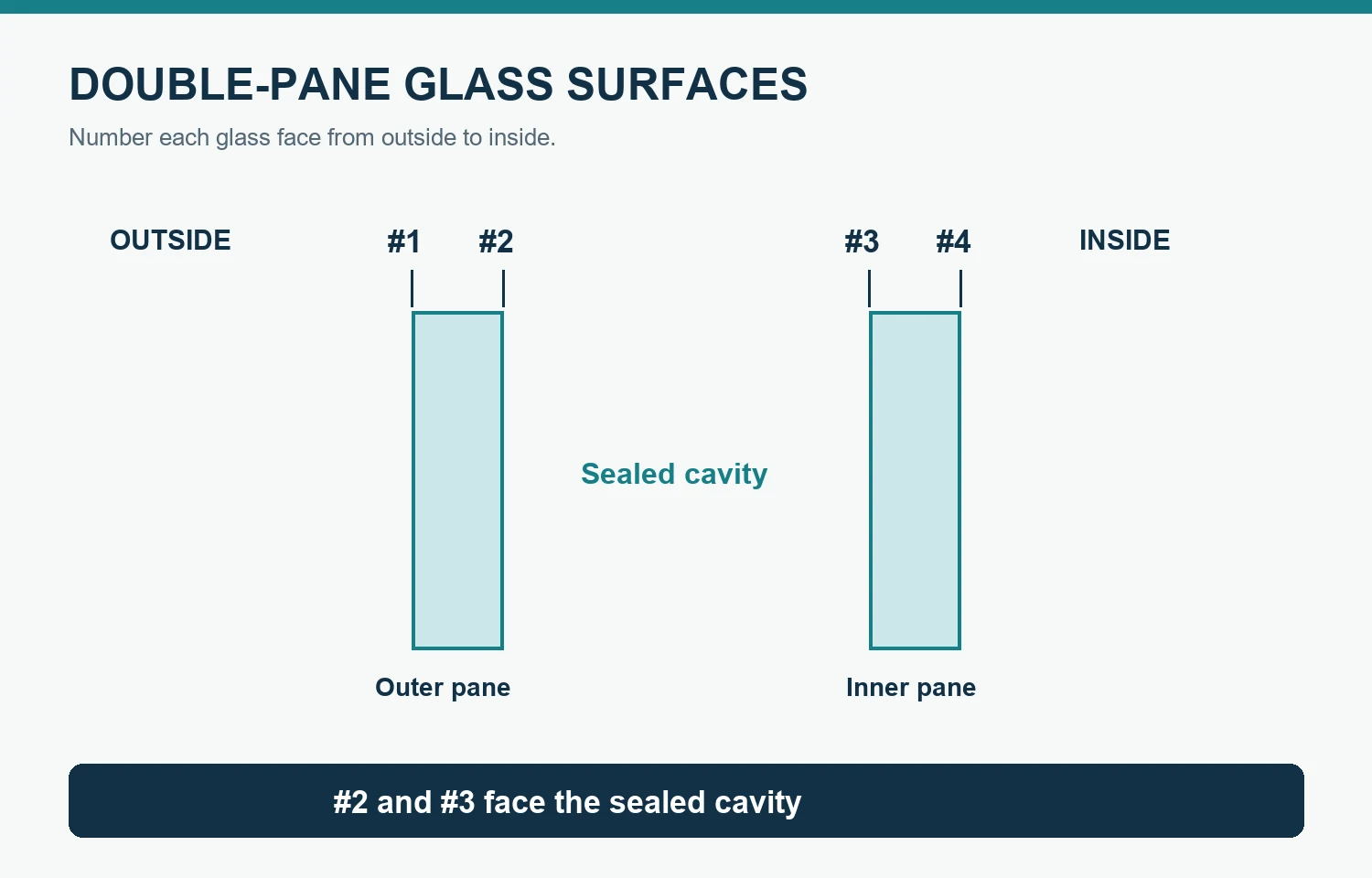
First: What Do Surface #1, #2, #3 and #4 Mean?
Take a conventional double-pane insulated glass unit.
Stand outside the building and move toward the room.
The four glass surfaces are numbered in that direction.
Surface #1
The exterior face of the outside pane.
It is directly exposed to weather.
Surface #2
The cavity-facing side of the outside pane.
Surface #3
The cavity-facing side of the inside pane.
Surface #4
The room-facing side of the inside pane.
So a double IGU looks conceptually like this:
OUTSIDE → #1 | glass | #2 → cavity → #3 | glass | #4 → INSIDE
Vitro Architectural Glass uses this same numbering convention and notes that Surfaces #2 and #3 face one another inside the insulating-glass cavity. Vitro surface numbering and coating placement
This matters because many high-performance soft-coat Low-E products are protected inside that sealed cavity rather than being exposed to weather or routine cleaning.
What Does Low-E Glass Actually Do?
Low-E means low emissivity.
The coating is an extremely thin metallic or metal-oxide layer designed to manage radiant heat transfer while still allowing useful visible light through the glass.
The U.S. Department of Energy explains that Low-E coatings lower window U-factor and can also be engineered to manage solar heat gain and visible daylight. Different coatings are designed for high, moderate or low solar gain. DOE window technologies
That last point is important.
There is no single universal “Low-E performance.”
Two Low-E products can have very different:
- Solar Heat Gain Coefficient;
- visible transmittance;
- reflectance;
- appearance;
- climate suitability.
So coating position should never be considered without looking at the coating itself.
Surface #2 Low-E: What Does It Do?
Surface #2 is the inner face of the exterior pane.
This is a very common location for solar-control Low-E coatings.
Vitro notes that solar-control Low-E coatings work best on the second surface. Vitro coating placement guidance
Why?
Moving a particular coating can change the inward-flowing portion of absorbed solar heat and the resulting SHGC. The effect depends on the coating and glass build-up; it should be checked in manufacturer data.
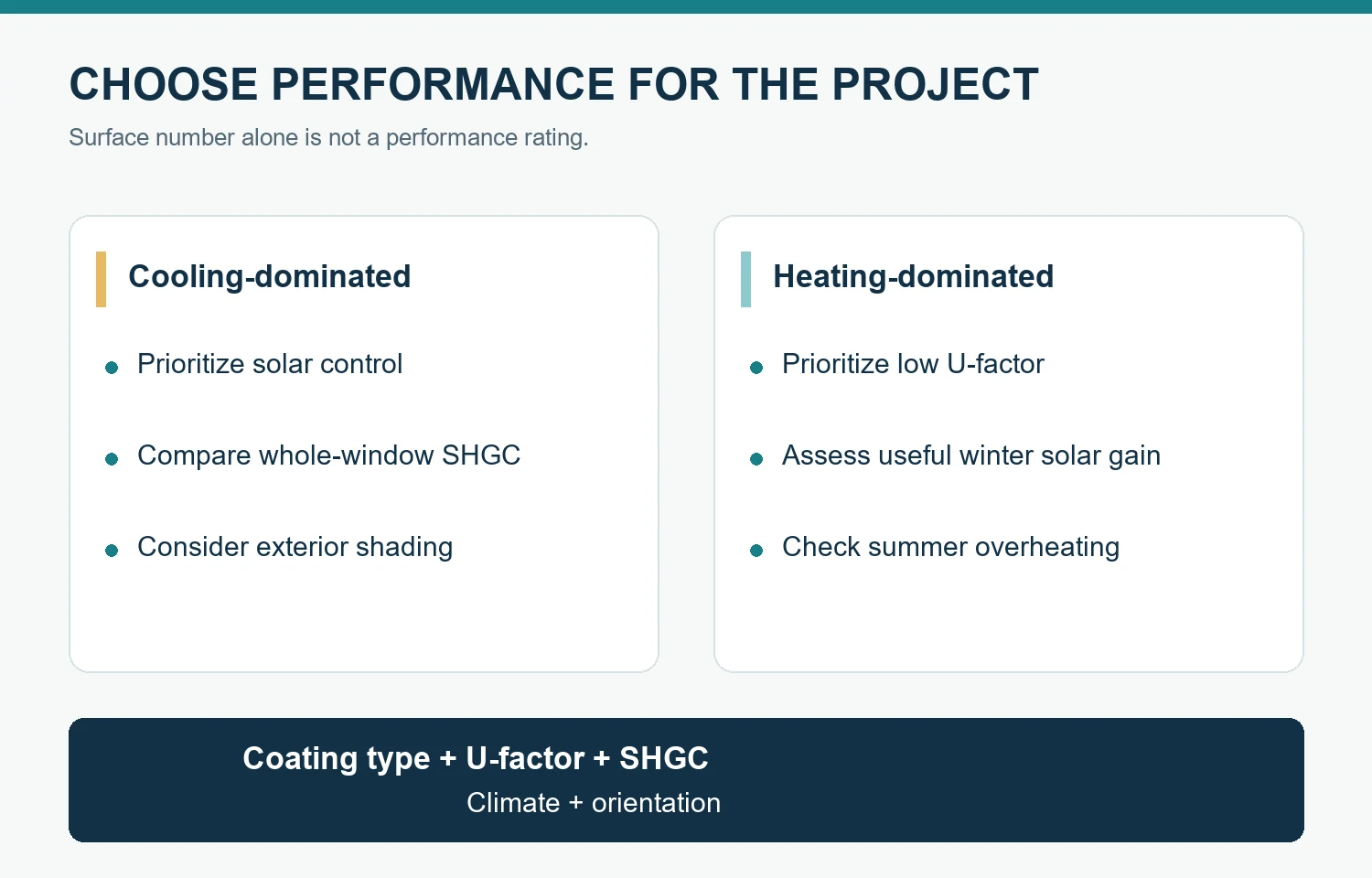
For cooling-dominated projects, that can be useful.
Surface #2 Is Often Considered When:
- summers are hot;
- air-conditioning loads are high;
- west-facing windows receive intense afternoon sun;
- large south/east/west glass areas create overheating;
- lower SHGC is a priority.
But this does not mean every Surface #2 Low-E product has the same SHGC.
The actual coating formulation still controls performance.
Surface #3 Low-E: What Does It Do?
Surface #3 faces the IGU cavity from the interior pane.
This position is often associated with passive or higher-solar-gain Low-E strategies.
Vitro's Sungate 400, for example, is specifically designed for heating-dominated climates and performs best as a third-surface coating in its intended configuration. Vitro Sungate 400 guidance
A higher-solar-gain strategy can be useful when the design wants to retain interior heat while still allowing beneficial winter solar energy into the building.
Surface #3 May Be Considered When:
- heating dominates annual energy use;
- useful winter solar gain is desired;
- the project uses passive-solar principles;
- south-facing glazing is intentionally designed to collect winter sun.
Again, this is a design strategy—not a universal rule for every Low-E product.
Does Surface #2 Have a Better U-Factor Than Surface #3?
This is where buyers often oversimplify the issue.
Do not assume coating position alone determines whole-window U-factor.
U-factor is affected by the complete window assembly:
- glass coating;
- number of panes;
- cavity width;
- gas fill;
- spacer;
- frame;
- thermal break;
- sash design;
- window size.
The U.S. Department of Energy explains that insulated glazing, gas fills, spacers and Low-E coatings all contribute to thermal performance. DOE window technologies
When buying a finished window, compare the certified whole-product U-factor rather than trying to calculate performance from the words “Surface #2” alone.
The More Important Difference: SHGC
For many #2-versus-#3 decisions, Solar Heat Gain Coefficient is the metric that makes the comparison easier to understand.
SHGC measures the fraction of solar energy that enters through a fenestration product.
ENERGY STAR explains it simply:
lower SHGC = less solar heat transmitted through the window. ENERGY STAR window guidance
That can be very valuable in hot climates.
But in a cold climate, extremely low solar gain is not automatically desirable on every facade.
ENERGY STAR recommends considering window orientation. In colder climates, a south-facing window may benefit from a higher SHGC combined with a low U-factor, while east- and west-facing windows often benefit from lower SHGC because of summer overheating. ENERGY STAR orientation guidance
This is why specifying one identical glass package for every elevation is convenient—but not always optimal.
Surface #2 vs #3 for Hot U.S. Climates
Imagine a modern house in Arizona, Texas or South Florida with large glass areas.
The main problem may be unwanted solar heat.
A west-facing room can become uncomfortable in late afternoon even when the air conditioner is running.
For that project, you would normally prioritize:
- low SHGC;
- appropriate U-factor;
- solar-control Low-E;
- exterior shading where practical.
A Surface #2 solar-control Low-E configuration is commonly used for this type of objective.
But do not order “Surface #2 Low-E” without asking for the actual SHGC.
The performance number matters more than the phrase.
Surface #2 vs #3 for Cold U.S. Climates
Now imagine a home in a heating-dominated climate.
The priorities change.
You want to minimize heat loss, so low U-factor becomes especially important.
But on a properly oriented south facade, useful winter sun can also help warm the building.
ENERGY STAR specifically notes that in colder climates an ideal south-facing window can combine a low U-factor with a higher SHGC, while east- and west-facing glazing may still benefit from lower solar gain. ENERGY STAR orientation guidance
A passive Low-E coating designed for Surface #3 may therefore make sense in some cold-climate applications.
The lesson is not:
cold climate = always Surface #3.
The lesson is:
choose the glazing performance for the actual climate, orientation and design objective.
Does the Aluminum Frame Still Matter?
Absolutely.
A high-performance glass package installed in a poor frame does not automatically produce a high-performance window.
For aluminum systems, check whether the frame uses an effective thermal break. RUTAO's energy-efficient aluminum windows guide explains the frame-and-glass concept; request current evidence for the specific system rather than applying general statements to an order.
The complete assembly determines the whole-product performance.
This is why ENERGY STAR products rely on independently tested and certified NFRC ratings rather than judging efficiency from glass marketing claims alone. ENERGY STAR window ratings
For a finished window, ask for whole-window ratings whenever they are available for the exact product configuration.
What Should You Put in an RFQ?
Instead of sending:
“Need Low-E double glass.”
send enough information for the supplier to understand the project.
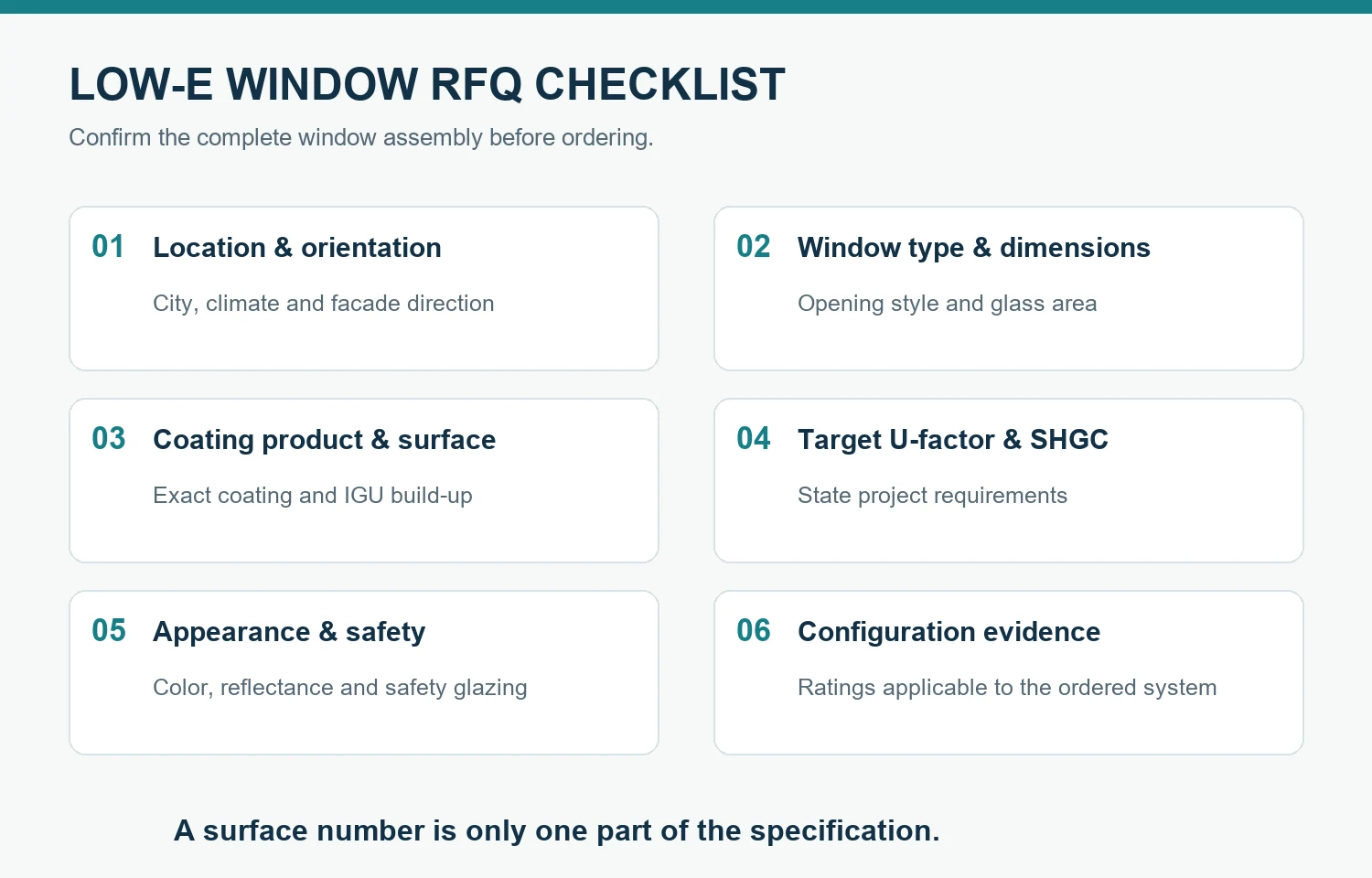
Project Location
City and state help establish climate.
Window Orientation
Identify major north, south, east and west elevations where relevant.
Window Size
Large glass areas can make solar-control decisions more important.
Target U-Factor
If the project has an energy-code or performance requirement, state it.
Target SHGC
This is especially important in cooling-dominated projects.
Glass Appearance
Tell the supplier whether you want:
- neutral;
- clear;
- blue;
- gray;
- bronze;
- reflective;
- low-reflectance.
Safety Requirements
Identify tempered, laminated or other safety-glazing requirements separately from Low-E performance.
What Should You Ask the Window Manufacturer?
Before approving the glass, ask:
Which Surface Is the Low-E Coating On?
Do not assume.
Have it shown in the glazing make-up.
What Is the Exact Glass Build-Up?
For example, the drawing should distinguish:
outer lite → coating → cavity → inner lite
rather than simply saying “double Low-E.”
What Are the Whole-Window U-Factor and SHGC?
If ratings are available, compare the finished product—not just center-of-glass values.
Is the Rating for My Exact Configuration?
Size, opening type and product series can matter.
Do not assume a test result from a different window automatically applies to yours.
Can I See a Glass Sample?
For premium residential projects, evaluate color and reflectance before mass production.
How RUTAO Approaches Custom Low-E Glazing
RUTAO supplies custom aluminum doors and windows for residential and commercial projects.
Depending on the window system and project requirements, glazing options can include:
- insulated double glazing;
- triple glazing;
- Low-E coatings;
- laminated glass;
- tempered glass;
- tinted glass;
- customized glass build-ups.
RUTAO's slim framed aluminum sliding windows, for example, can be configured with double-glazed IGUs and optional Low-E glass.
For an energy-focused project, however, do not start with:
“Give me your standard Low-E.”
A better RFQ is:
location → orientation → window type → dimensions → target U-factor → target SHGC → glass appearance → safety requirements
Availability and coating position must be confirmed for the selected product series. A specification shown on one RUTAO product page does not establish a standard configuration for every RUTAO window.
Final Answer
So, which is better: Low-E on Surface #2 or Surface #3?
Neither is universally better.
Surface #2 is commonly used with solar-control Low-E products where reducing unwanted solar heat is a priority.
Surface #3 can be used with passive Low-E strategies where retaining indoor heat while allowing useful solar gain is part of a heating-dominated design.
But surface number alone does not specify window performance.
Before ordering, compare:
U-factor + SHGC + VT + coating type + IGU construction + frame + climate + orientation.
For a project-specific discussion, contact RUTAO with your location, drawings and performance requirements.
If your supplier only tells you:
“It has Low-E glass,”
you still do not know enough.
Frequently Asked Questions
Is Surface #2 or Surface #3 better for Low-E windows?
Neither is universally better. Compare the coating type, whole-window U-factor and SHGC, climate, orientation and shading. Confirm the coating manufacturer's recommended placement for the exact glass build-up.
What is the difference between Surface #2 and Surface #3?
In conventional double-pane insulating glass, Surface #2 is the cavity-facing side of the outer pane. Surface #3 is the cavity-facing side of the inner pane. Both face the sealed cavity.
Does Surface #2 automatically mean a lower U-factor?
No. Surface position alone does not establish whole-window U-factor. The coating, panes, cavity, gas fill, spacer, frame and sash all contribute to the final rating.
Should every window in a home use the same Low-E glass?
Not necessarily. Different orientations and shading conditions can create different solar-gain priorities. Evaluate performance and appearance together before specifying different glazing packages.
Does every RUTAO window use the same Low-E configuration?
No universal configuration is stated here. Confirm available glazing, coating position and supporting performance evidence for the particular RUTAO product series and ordered configuration.