If you are shopping for impact windows in Florida, hurricane ratings are usually the first numbers you look at.
But homeowners living near I-95, an airport, a railway or a busy street often have another question:
How much outside noise will the windows actually reduce?
That is where two acoustic ratings begin to appear: STC and OITC.
They look similar because both are expressed as single numbers, and in both cases a higher number generally means better sound isolation. But they do not measure exactly the same thing.
For a Florida homeowner dealing with traffic, aircraft or other outdoor noise, that difference matters.
In August 2026, the Fenestration and Glazing Industry Alliance released an updated technical report specifically clarifying Sound Transmission Class and Outdoor-Indoor Transmission Class for exterior fenestration products. That update is a useful reminder that acoustic performance should not be reduced to one generic “soundproof” number. FGIA acoustical update
This guide explains how STC and OITC differ, why impact glazing can help reduce noise, and what you should ask for when comparing aluminum impact windows.
What Is STC?
STC stands for Sound Transmission Class.
It is a laboratory-derived single-number rating used to describe how effectively a building assembly reduces airborne sound transmission.
For laboratory testing, sound-transmission-loss data are measured and then classified into an STC value. STC is calculated from sound-transmission-loss data under the applicable test and classification methods. ASTM E413
Higher numbers indicate greater resistance to airborne sound.
That makes STC useful for comparing products, but it has an important limitation.
STC Was Not Designed Specifically for Transportation Noise
Traffic, aircraft, trains and heavy mechanical equipment can contain substantial low-frequency energy.
Some of that energy falls below the frequency range that strongly influences an STC rating.
A window can therefore have an attractive STC number but perform less impressively against the deep rumble of trucks, aircraft or trains than a buyer expected.
That is one reason OITC deserves attention.
What Is OITC?
OITC stands for Outdoor-Indoor Transmission Class.
Unlike STC, OITC is specifically intended to evaluate the transmission of outdoor noise into a building.
The rating is defined under ASTM E1332 and considers a range extending down to about 80 Hz, giving more weight to lower-frequency exterior noise. ASTM E1332 ASTM E413
That makes OITC particularly relevant to sources such as:
- road traffic;
- aircraft;
- railway noise;
- buses and heavy trucks;
- urban exterior noise.
OITC can be useful for transportation noise with strong low-frequency content. It is not a universal predictor: tire noise, horns and some aircraft spectra can differ from its reference spectrum. For difficult sites, compare frequency-specific data with the actual noise source.
STC vs OITC: The Simple Difference
Think of it this way.
STC
Useful for understanding general airborne sound isolation, particularly across speech and mid-frequency ranges.
OITC
More focused on how an exterior building component deals with real outdoor transportation noise, including lower frequencies.
Neither number is “better” in every situation.
The right rating depends on the sound you are trying to control.
| Situation | Rating to Pay More Attention To |
|---|---|
| Conversations and general neighborhood noise | STC |
| Highway traffic | OITC |
| Aircraft | OITC |
| Railway noise | OITC |
| General product comparison | STC + OITC |
| Exterior façade acoustic design | OITC usually deserves greater weight |
FGIA’s newly updated acoustical guidance specifically differentiates these two classifications for fenestration products, reinforcing the importance of selecting the rating that matches the intended use. FGIA acoustical update

How Impact-Window Construction Can Affect Noise
Impact windows are designed primarily for hurricane and debris protection—not as dedicated studio soundproofing products.
However, several construction features that help them resist impact can also improve acoustic performance.
Laminated Glass Adds Damping
Impact glazing commonly uses two layers of glass bonded to a flexible polymer interlayer.
That interlayer helps hold broken glass together following impact.
It can also reduce vibration passing through the glazing assembly.
Instead of behaving exactly like one thin monolithic pane, laminated glass has additional mass and damping. Vitro’s acoustic guidance discusses glazing configuration and the need for system testing.
More Mass Can Help
In general, heavier glazing can reduce sound transmission compared with a thin single pane.
But glass thickness should not be viewed in isolation.
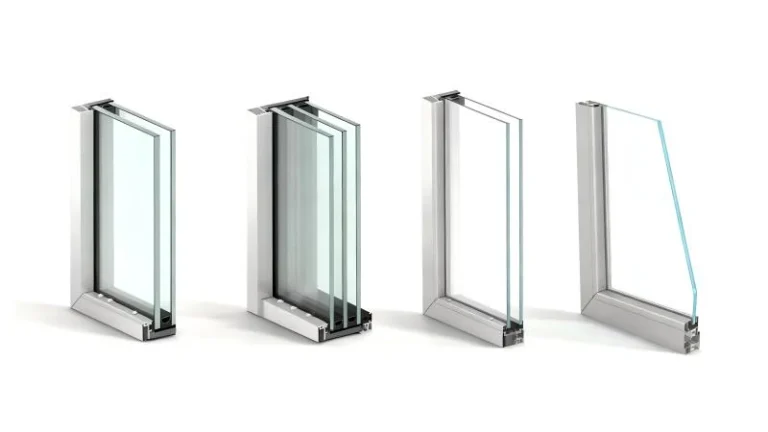
The complete acoustic result depends on the combination of:
- glass thickness;
- laminated interlayer;
- air space;
- pane asymmetry;
- frame;
- seals;
- installation.
Tighter Window Seals Matter
Sound will travel through gaps.
An expensive acoustic glass package can underperform if the window does not close tightly or if the perimeter installation leaves paths for air—and therefore sound—to move through.
This is why the acoustic rating of the complete tested window assembly is more useful than simply asking how many millimeters thick the glass is.

Is Laminated Glass Better Than Double-Pane Glass for Noise?
There is no universal winner.
A standard double-pane insulated glass unit can provide better thermal performance than an old single-pane window, but two panes alone do not guarantee excellent acoustic performance.
Laminated glass contributes damping through the interlayer.
An insulated laminated glass unit can combine:
- laminated glazing;
- a sealed air space;
- different glass thicknesses;
- Low-E performance;
- acoustic optimization.
That combination can be useful when a project needs hurricane resistance, energy efficiency and noise control at the same time.
However, buyers should avoid assuming that every impact IGU automatically has the same STC or OITC.
Configuration matters.
What About Homes Near Airports?
Airport noise is another situation where OITC becomes important.
Florida has major residential areas near airports such as:
- Miami International Airport;
- Fort Lauderdale-Hollywood International Airport;
- Orlando International Airport;
- Tampa International Airport;
- Palm Beach International Airport.
Aircraft noise contains significant low-frequency energy, particularly during takeoff.
An attractive STC value does not automatically tell you everything you need to know about how that window will handle aircraft noise.
For homes close to flight paths, ask the window supplier for:
both STC and OITC data for the exact configuration.
If the noise problem is severe, the project may also require professional acoustic analysis rather than relying on a generic residential window recommendation.
Are Higher STC and OITC Numbers Always Better?
From an acoustic perspective, higher ratings generally indicate greater sound attenuation.
But buying the highest number available is not always the smartest approach.
A window also needs to meet other project requirements.
For Florida impact projects, also review impact window design pressure and the other project requirements:
- impact classification;
- design pressure;
- opening size;
- air infiltration;
- water resistance;
- U-factor;
- SHGC;
- corrosion resistance;
- hardware;
- local product approval requirements.
A highly acoustic window that does not meet the required structural or impact performance is not the correct product.
The objective is to balance the full specification.
Why You Should Ask for Ratings From the Exact Window
One of the biggest mistakes in window shopping is using a glass-only rating as though it represents the entire installed window.
It may not.
The frame changes performance.
So does window style.
A fixed window seals differently from a horizontal slider. A compression-sealed casement operates differently from a sliding sash.
Even within the same product line, changing the glass package can change the acoustic result.
Ask for data that corresponds to:
- the exact window series;
- the actual operating type;
- the actual glass configuration;
- ideally, the tested size or applicable configuration.
Does Installation Affect Noise Reduction?
Yes.
Laboratory acoustic ratings are measured under controlled conditions.
Your home is not a laboratory.
Sound can travel around a high-performance window through:
- gaps around the frame;
- exterior doors;
- wall assemblies;
- soffits;
- roof construction;
- vents;
- poorly sealed penetrations.
ASTM laboratory ratings therefore should not be treated as a guarantee of identical room-level performance after installation.
Industry acoustic guidance also emphasizes the difference between controlled laboratory performance and field conditions. Vitro acoustic guidance
For a replacement window, careful perimeter sealing is particularly important.
Can Impact Windows Make a Room Completely Soundproof?
No.
The term soundproof is usually too strong.
Good windows can substantially reduce transmitted exterior noise, but they cannot stop every frequency, and the window is only one part of the building envelope.
If an exterior wall, door or roof allows significant sound transmission, installing a better window does not eliminate those other paths.
The realistic goal is:
meaningful noise reduction, not absolute silence.
What Should Florida Homeowners Ask Before Ordering?
If exterior noise matters to your project, add these questions to your window specification.
What Is the STC Rating?
Ask for the exact tested product or configuration.
What Is the OITC Rating?
This is particularly important for traffic, aircraft and railway noise.
Is the Glass Laminated?
Do not assume every insulated glass unit is acoustically optimized.
Is It an Insulated Laminated Unit?
This may improve the combination of acoustic and thermal performance.
Are Different Glass Thicknesses Available?
Asymmetric glass configurations can sometimes improve performance across certain frequencies.
Does the Rating Apply to the Whole Window?
A glass-only value is not necessarily equivalent to a complete window-system value.
What Other Performance Requirements Apply?
For Florida projects, acoustic design must still be coordinated with hurricane impact, design pressure, water resistance and applicable approval requirements.
RUTAO Custom Aluminum Impact Windows
RUTAO manufactures customizable aluminum windows and doors for residential and commercial projects.
For a project where both hurricane protection and noise control are important, the specification can be developed around:
- aluminum window type;
- opening dimensions;
- laminated glass;
- insulated laminated glazing;
- Low-E options;
- glass thickness;
- frame finish;
- hardware;
- required structural performance.
Explore RUTAO’s aluminum window options and provide the project requirements before selecting a configuration.
For acoustic-sensitive projects, however, STC or OITC performance should only be claimed where test documentation exists for the specific window and glazing configuration.
A generic claim such as “reduces 40 dB” should not replace product-specific laboratory data.
Final Answer: Should You Compare STC or OITC?
For most Florida homeowners, the best answer is:
compare both.
STC gives you a useful general measure of airborne sound isolation.
OITC deserves particular attention when the main problem is outdoor transportation noise such as highways, aircraft or trains.
If you live beside a quiet residential street, a good STC improvement may already produce noticeable comfort.
If your home is near I-95, a flight path or a railway corridor, ask for OITC as well.
Send RUTAO your opening sizes and acoustic requirements to discuss a documented configuration. The acoustic number is only one piece of the window specification.
For an impact-window project, hurricane performance, design pressure, frame construction, glazing, seals and installation all need to work together.
Frequently asked questions
Is STC or OITC better for impact windows?
Neither is universally better. STC is useful for general airborne sound isolation, while OITC is generally more relevant for exterior transportation noise such as highways, aircraft and trains.
What does OITC mean on a window?
OITC means Outdoor-Indoor Transmission Class. It rates an assembly against a reference outdoor-noise spectrum. Ask for the complete window configuration and remember that the noise at your site may have a different spectrum.
Does a higher STC rating mean a quieter window?
Generally, a higher STC indicates better airborne sound isolation under the test conditions. However, STC alone may not fully represent low-frequency traffic or aircraft noise.
Does impact resistance prove a window has a high acoustic rating?
No. Impact resistance and acoustic performance address different requirements. Request configuration-specific STC and OITC test data alongside the applicable impact and structural documentation.
Can a glass-only rating represent the complete window?
Not automatically. Frame design, seals, operating style and installation affect sound transmission. Compare test documentation for the actual window and glazing assembly.