Florida’s new home-hardening sales-tax refund has generated an obvious question for condominium owners:
If my condo association buys the impact windows, can I still claim the refund?
The answer may be yes.
Guidance obtained by Florida Realtors from the Florida Department of Revenue indicates that an individually owned Florida condominium unit can qualify for the state’s new Home Hardening Products Sales Tax Refund when the unit meets the program’s eligibility requirements.
Even more importantly, the condo owner does not necessarily have to be the person who purchased the windows directly.
Florida Realtors reported after contacting the Department of Revenue that qualifying owners may still apply when a condominium association or contractor handled the purchase, provided the required sales-tax and installation documentation can be produced. Source
That clarification matters for condo projects because hurricane-window replacement is often organized building-wide rather than unit by unit.
Here’s what Florida condo owners should understand before assuming they qualify for the refund.
What Is the Florida Home-Hardening Sales Tax Refund?
Florida created a new sales-tax refund for qualifying home-hardening products beginning in 2026.
The current statute covers qualifying:
- impact-resistant windows;
- impact-resistant exterior doors;
- impact-resistant garage doors.
The purchase period runs from July 1, 2026 through June 30, 2029.
Rather than eliminating sales tax at checkout, the program works as a refund.
The sales tax is paid first. The eligible property owner then applies to the Florida Department of Revenue to recover qualifying Florida sales tax, subject to a maximum refund of:
up to $500 per eligible residential property.
The current Florida statute also sets the application window through September 30, 2029. Source
Can a Florida Condo Unit Qualify?
Yes, potentially. Florida Realtors reports guidance it obtained directly from the Department of Revenue: individually owned condominium units can qualify, including when an association or contractor buys the products. This is reported agency guidance, not an approval of any individual application.
What Does a Condo Owner Need to Qualify?
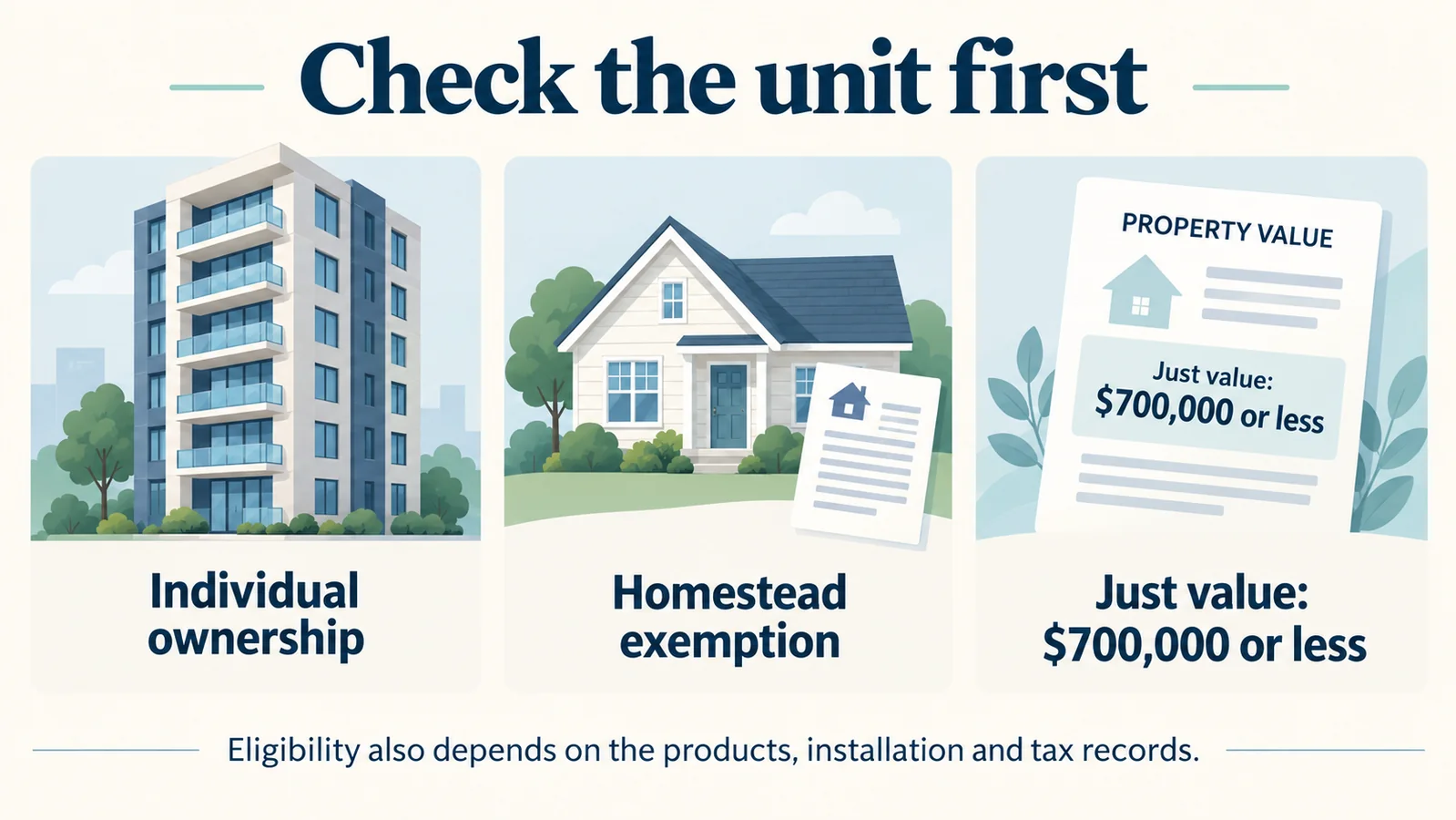
Being located in a condominium building is not enough by itself.
The individual property still has to satisfy the eligibility rules.
The Condo Must Be Individually Owned
The applicant must be the owner of the eligible residential property.
Florida law defines an owner as the person holding legal title to the property. Source
The Unit Needs a Homestead Exemption
This is one of the biggest limitations.
The eligible residential property must have been granted a Florida homestead exemption.
That means a Florida condo used purely as a second home, vacation property or investment rental should not automatically be assumed eligible.
Check the property’s homestead status before calculating the refund into the project cost.
Just Value Must Be $700,000 or Less
The eligible property must also have a just value of $700,000 or less.
This is not necessarily the same number as:
- the price you paid;
- Zillow’s estimated value;
- your mortgage balance;
- the taxable value after exemptions.
The safest approach is to verify the relevant value through the county property appraiser.
Florida Realtors’ condo-specific guidance confirms the same $700,000 limit for qualifying units. Source
What If the Condo Association Bought the Windows?
This is probably the most valuable part of the new clarification.
Large condominium buildings frequently replace exterior windows through an association-wide project.
The association may:
- select the contractor;
- negotiate the window package;
- purchase the products;
- pay the contractor;
- allocate the cost to unit owners.
At first glance, that creates a problem because the individual homeowner may not possess a normal retail receipt with his or her name on it.
However, Florida Realtors reports that the Department of Revenue confirmed that the individual unit owner may still apply even when the association or contractor purchased the qualifying products. Source
The documentation becomes critical.
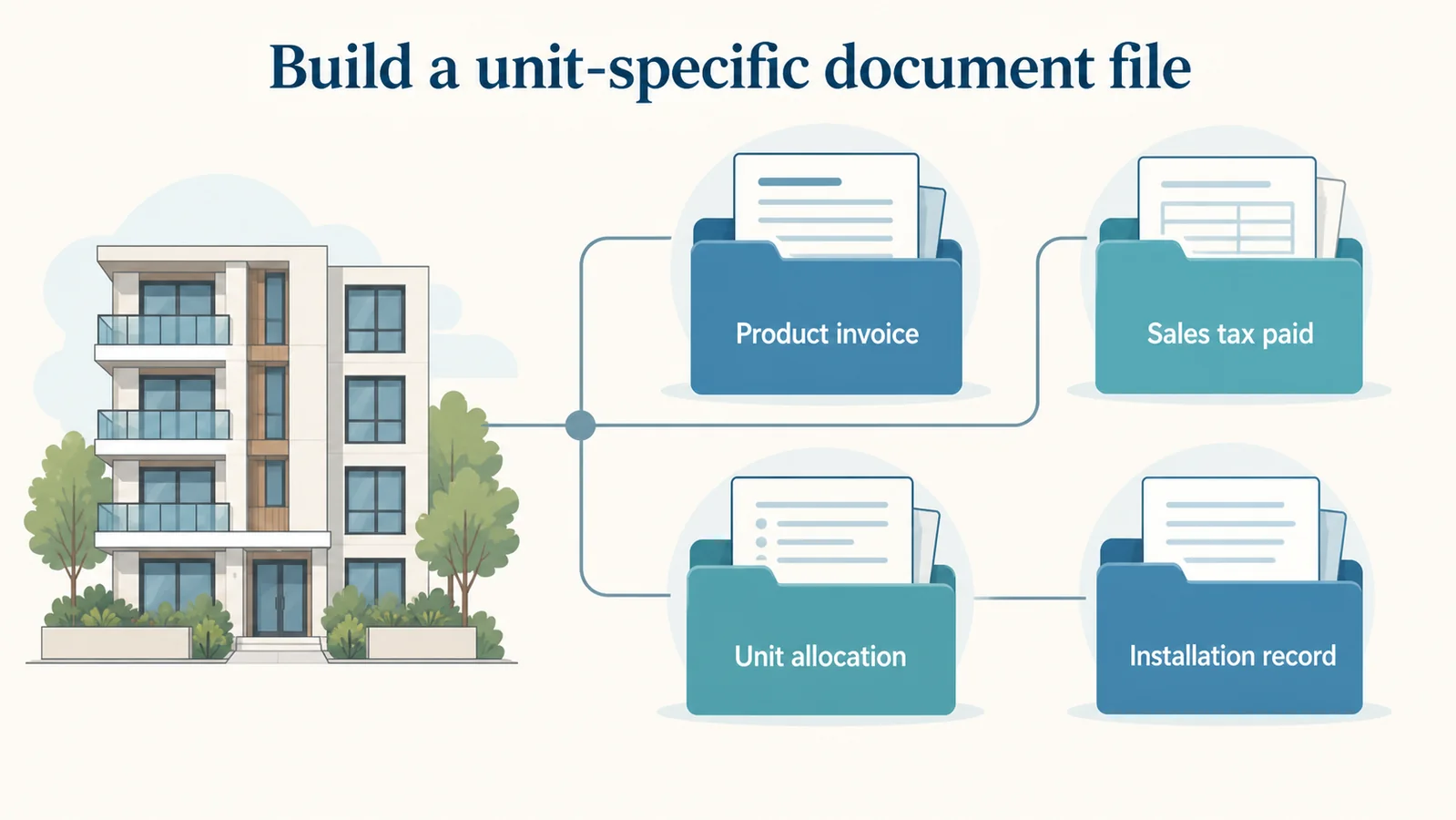
The unit owner needs evidence showing that Florida sales tax was actually paid on the qualifying products.
What Documentation Should Condo Owners Request?
Do not wait until 2029 to ask your condo association for paperwork.
If an association is coordinating an impact-window project now, request documentation while the project records are still easy to locate.
Useful records can include:
Itemized Invoice
The paperwork should make it possible to identify the qualifying impact windows or doors associated with the unit.
Evidence of Florida Sales Tax Paid
This is fundamental because the program refunds previously paid Florida sales tax.
The statute requires receipts evidencing the payment of sales tax to accompany the claim. Source
Product Information
Keep documentation identifying the actual impact-resistant window or door system.
Installation Records
The homeowner must certify that the qualifying home-hardening products were installed on the eligible property.
Parcel Information
Florida Realtors reports that DR-26HH requests the property’s parcel number as part of the filing information. Source
For a large condo project, the association or contractor should ideally prepare unit-specific documentation rather than forcing every owner to reconstruct the project later.
Which Impact Windows Count?
Not every replacement window qualifies simply because it is installed in Florida.
Florida’s statute defines qualifying impact-resistant systems through specified performance criteria.
Applicable pathways include testing under standards such as:
ASTM E1886 and ASTM E1996
These standards address performance of exterior windows, doors and protective systems exposed to wind-borne debris.
AAMA 506
Another recognized pathway identified by Florida’s home-hardening statute.
TAS 201, TAS 202 and TAS 203
These Florida test protocols address impact, structural pressure and cyclic wind-pressure performance.
The statutory definition also recognizes that a qualifying glazing or door system can include the frame and attachment hardware when they are part of the same sale and intended for installation according to the prescribed engineering requirements. Source
This is why buyers should not focus only on the glass.
An impact window is a complete system. Review impact-window design pressure alongside the product documents when assembling the project specification.
What If Only Some Condo Windows Are Replaced?
The tax-refund program should not be confused with Florida building-code requirements or insurance opening-protection classifications.
The refund focuses on qualifying home-hardening products installed on an eligible property.
Whether a particular condo renovation must replace all exterior openings—or whether the resulting installation earns a specific insurance mitigation classification—is a different question.
Those issues can involve:
- local permitting;
- Florida Building Code;
- HVHZ requirements;
- product approval;
- association rules;
- wind mitigation.
Do not assume that receiving a sales-tax refund proves that the entire unit or building meets a particular insurance classification.
How Does a Condo Owner Apply?
Florida Department of Revenue currently lists DR-26HH — Home Hardening Products Sales Tax Refund among its official sales-and-use-tax refund forms. Source
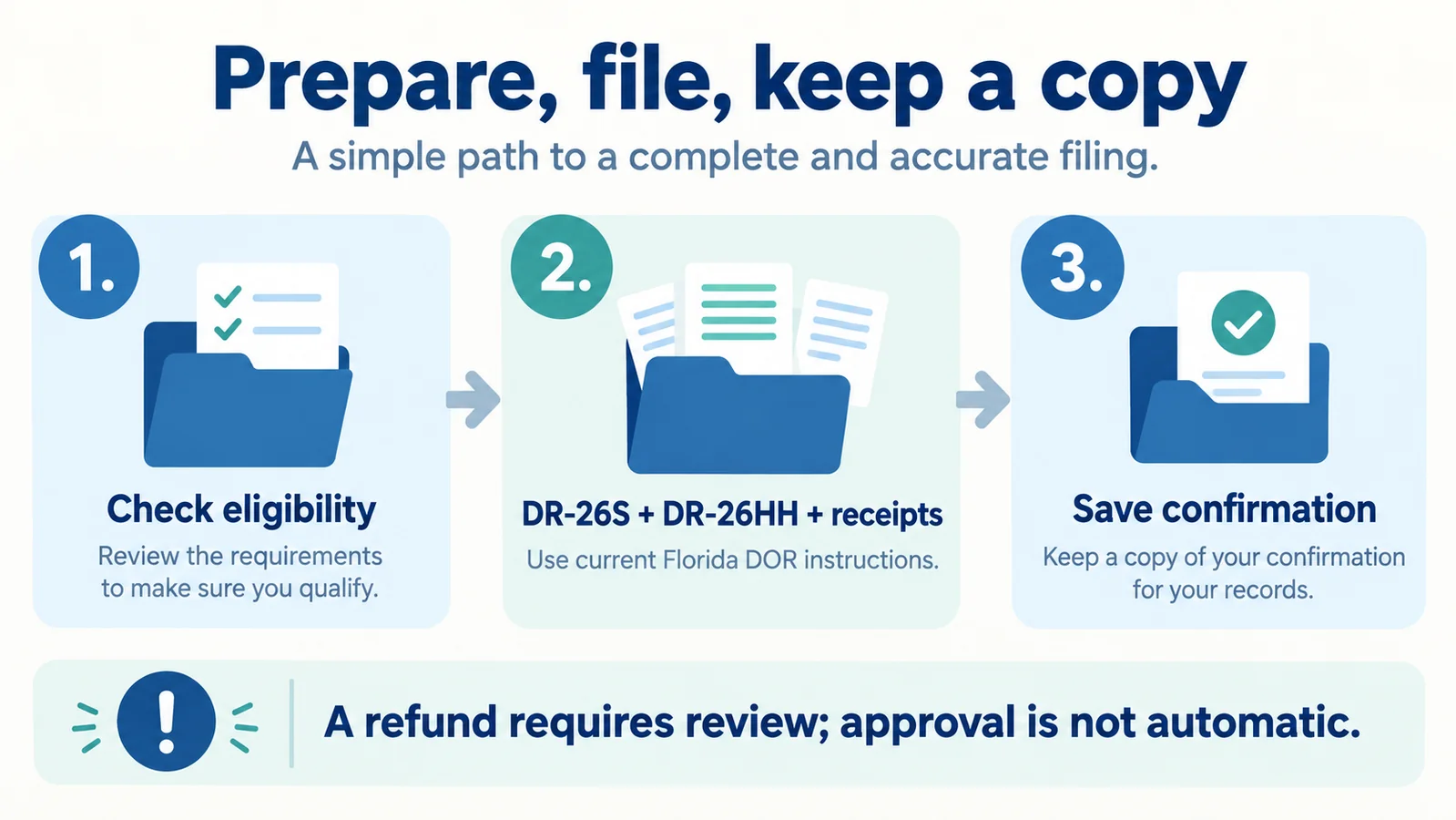
The current DR-26HH instructions say owners should submit:
Form DR-26S — Application for Refund, Sales and Use Tax
together with:
Form DR-26HH — Home Hardening Products Sales Tax Refund
and supporting receipts/documentation. Current DR-26HH instructions
Florida DOR’s general refund system also provides online sales-and-use-tax refund filing and supporting-document submission. Source
For online filing, submit DR-26S through the Department of Revenue refund system, then upload your completed DR-26HH and supporting documents. Follow the current DR-26HH instructions for the mail option. Keep a copy of the full submission and any confirmation. Use current Department forms rather than an old copy from an unrelated website.
How Much Can a Condo Owner Receive?
The maximum is:
up to $500 per eligible residential property.
This does not mean every condo owner automatically receives $500.
The program refunds qualifying Florida sales tax previously paid.
For example, if the eligible tax attributable to the qualifying products is below $500, the refund would not magically increase to $500.
If the qualifying sales tax exceeds $500, the statutory maximum still applies.
The owner may submit an application for only one eligible residential property under the program. Source
When Should Condo Owners Apply?
Qualifying products must be purchased during:
July 1, 2026 – June 30, 2029
and refund applications must be submitted no later than:
September 30, 2029. Source
The statute also gives the Department 30 business days after receiving an application to determine whether it meets the program requirements and another 30 business days after formal approval to issue the refund. Source
That is another reason to submit complete documentation.
Missing receipts or unclear unit allocation can slow the process.
What Should Condo Boards Do Before Ordering Impact Windows?
For a large condominium project, paperwork should be discussed during procurement—not after installation.
Boards and property managers should consider asking suppliers and contractors for:
Unit-Level Product Schedules
Which windows and doors belong to which unit?
Itemized Cost Allocation
How much qualifying product cost and sales tax is attributable to each unit?
Exact Product Documentation
What window series, glass configuration and impact documentation applies?
Installation Records
When and where were the products installed?
Copies of Tax-Paid Invoices
Can the association provide owners with records suitable for a refund application?
That planning can make a major difference when dozens or hundreds of unit owners later request documentation.
RUTAO Impact Windows for Florida Condo Projects
RUTAO manufactures custom aluminum windows and doors for residential and commercial projects. Its aluminum impact awning window range is one starting point for a project discussion; the actual supplied configuration and its supporting documents must be reviewed.
For condominium projects, customization can include:
- window dimensions;
- aluminum profiles;
- laminated glazing;
- insulated glass;
- Low-E options;
- frame finishes;
- operating styles;
- project schedules.
But a Florida condo project requires more than custom dimensions.
The specified system should be matched to the project’s structural, impact, permitting and documentation requirements before manufacturing.
If owners intend to pursue Florida’s home-hardening refund, product and invoice documentation should also be considered during procurement.
A custom product does not automatically qualify for the refund. Qualification depends on the actual supplied system and the homeowner’s eligibility.
Before Your Association Places the Order
Ask for unit-specific invoices and tax documentation while the project is being planned. Keep the original supplier records with the allocation explanation, and resolve missing tax amounts before signing the affidavit. These are practical recordkeeping recommendations; the Department of Revenue determines whether a submitted claim qualifies.
For a project quotation, send RUTAO your opening schedule and specifications. Keep refund eligibility and product acceptance as separate checks throughout procurement.
Frequently Asked Questions
Can Florida condo owners claim up to $500 in impact-window tax refunds?
Qualifying individually owned condo units may be eligible. The unit must meet the program requirements, including homestead status and the applicable property-value limit.
Can I claim the refund if my condo association bought the windows?
Recent Florida Department of Revenue guidance reported by Florida Realtors says a qualifying unit owner may apply even when an association or contractor made the purchase, provided the required documentation shows Florida sales tax was paid.
Does my Florida condo need a homestead exemption?
Yes. The eligible residential property must have a Florida homestead exemption under the current program.
What is the maximum refund?
The refund is limited to qualifying Florida sales tax actually paid, with a maximum of $500 per eligible residential property.
Which forms do condo owners use?
Use the current Form DR-26S together with Form DR-26HH and the required supporting receipts, following Florida Department of Revenue instructions.
When is the deadline?
Qualifying purchases run through June 30, 2029, and the current statutory application deadline is September 30, 2029.